

Pressure differential systems in high-rise buildings. How to design effectively under increasing requirements?
As buildings grow taller and more complex, the demands on fire safety systems increase accordingly. In buildings over 25 meters, pressure differential systems are increasingly becoming the standard. This is no coincidence – natural smoke extraction systems in high-rise buildings are more susceptible to changing external conditions, such as wind or the stack effect. The taller the building, the greater the scale of these effects. Consequently, designing an effective pressure differential system is becoming one of the key design challenges in modern construction.
What does “Safe evacuation” mean in practice?
A pressure differential system is designed to ensure that escape routes – stairwells, fire-protected lobbies, or lift shafts – remain smoke-free during a fire.
Achieving this goal requires the simultaneous fulfilment of several key conditions:
- Maintaining the required overpressure when doors are closed,
- Ensuring the required airflow rate when doors are open,
- Preventing excessive pressure build-up so that emergency doors can still be opened,
- Complying with the requirements of EN 12101-6 (testing and certification of the system) and EN 12101-13 (design, installation, and maintenance).
A solution based on the requirements defined in the standards serves as a starting point. However, the crucial factor is the correct applying these requirements into the actual conditions of the building – its airtightness, the system resistance characteristics, door layout, and available plant space.
The “Heart” of the System – the role of the pressurisation unit
If we compare a pressure differential system to a living organism, the pressurisation unit functions as its heart. It is responsible for generating and precisely maintaining overpressure in stairwells, fire-protected lobbies, and lift shafts. It must respond dynamically – in under 3 seconds increasing airflow when an emergency door is opened, stabilising the parameters, and preventing smoke from entering the protected zone.
The effectiveness of the entire system depends on several key factors: rapid response with stable pressure recovery, precise regulation, the ability to operate under changes in building airtightness and external environmental conditions, and the reliability of automation and communication systems. In high-rise buildings, the tolerance for error is minimal – any deviation from required pressure parameters can have direct consequences for occupant safety.
Design challenges in 2026
Today’s challenges for designers rarely concern airflow calculations alone. Increasingly, the problem lies in the practical feasibility of implementation.
The most common challenges include:
- limited space in plant rooms,
- elevated system pressures in high-rise buildings,
- the need to integrate with complex fire automation systems,
- rooftop unit placement and exposure to environmental conditions,
- tight project and installation schedules.
In practice, designing a system requires both accounting for the building’s specific airtightness and layout parameters and accommodating spatial constraints, while simultaneously meeting the required performance criteria.
Evolution of technology – greater flexibility without compromise
The development of pressure differential systems increasingly focuses not on revolution, but on enhancing the versatility and accessibility of the technology.
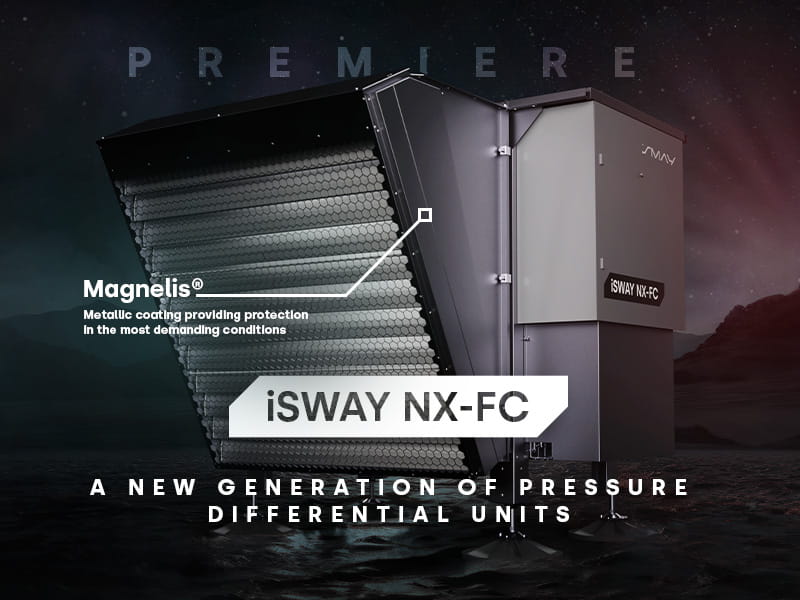
An example of this trend is the new generation iSWAY NX-FC unit – a compact pressure differentiation unit designed with:
- extended operating range (particularly at elevated pressures),
- greater flexibility in selection,
- reduced dimensions,
- improved corrosion resistance – casing made of Magnelis® steel (Zn-Al-Mg coating according to EN 10346),
- integrated accessories (combined air intake and damper),
- reduced installation and commissioning time.
From a technical perspective, the extended operating range is of key importance. New operating points available in the higher pressure range allow higher-resistance installations to be served within the same system architecture.
At the same time, key parameters have been preserved:
- fast control response (< 3 s),
- adaptive algorithm that adjusts to the building’s characteristics,
- automated daily self-testing (SELFTEST).
This is a development direction in which technology directly translates into greater design flexibility.
Case Study: scale and redundancy
A compelling example of the scale of challenges in residential construction is The Portal – a 120-metre building in London featuring 350 residential apartments.
The protection of escape routes there is ensured by a total of 54 iSWAY units, including 27 purpose-designed standby units. This project demanded not only demanding performance requirements and absolute reliability, but also redundancy while maintaining the minimal unit footprint for compact units and simplified installation.
In such buildings, safety cannot rely on compliance with minimum standards alone – it must be engineered for absolute reliability.
Implications for HVAC and Fire Protection Designers
From the perspective of an HVAC and fire protection designer, the development of pressurisation units delivers:
- greater flexibility in selection for projects with elevated system resistance,
- greater flexibility in unit placement (rooftop or plant room) in space-constrained plant rooms,
- minimised risk of installation errors,
- the ability to deploy a proven, certified solution across a broader range of building types and configurations.
In practice, this means that a proven, high-performance solution for escape route protection can now be used in locations where it was previously impractical or cost-prohibitive.
The Future Direction of Fire Safety Systems
The height and complexity of buildings will continue to increase. Fire safety systems must evolve accordingly with this trend – not only in terms of performance, but also in terms of adaptive control capability, reliability, and ease of installation and commissioning.
Automated self-testing (SELFTEST), predictive, adaptive control algorithms, greater component integration, and enhanced material durability are elements that are becoming baseline expectations in modern fire safety design.
In systems where occupant safety is at stake, it is not only about regulatory compliance. It is about predictable performance when it matters most – in fire mode.
And this always begins with a correctly designed “heart” of the system.

