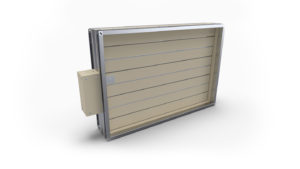
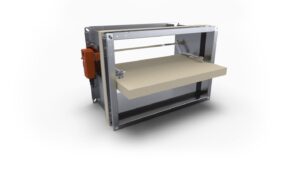
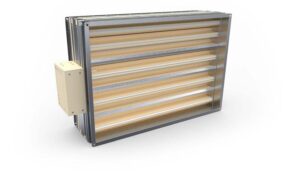
KTQ-O Round fire damper for quick installation
KTQ-O fire dampers for quick installation are designed for use in general ventilation systems as cutoff barriers, separating the fire-affected zone from the rest of the building (normally open). The function of fire dampers is to prevent the spread of fire, heat, and smoke.
KTQ-O fire dampers are CE marked and hold the Certificate of Constancy of Performance No. 2434-CPR-0382, issued by CTO Gdańsk, in compliance with the requirements of the PN-EN 15650 standard.
KTQ-O fire dampers are classified in the following fire resistance classes and may be installed in the following building partitions:
KTQ-O-E dampers (with electric actuator): EI 120 (ve ho i↔o) S
• concrete ceilings (floors) with 150 mm in thickness or more, and a fire resistance class EI120 or higher.
• rigid walls with a thickness of 100 mm or more and EI120 or a higher fire resistance class (e.g. concrete walls, solid brick walls, cellular concrete block walls, hollow masonry unit walls or concrete slab walls),
• flexible walls with a thickness of 100 mm or more and EI120 or a higher fire resistance class (thicker, higher density, more board layers).
KTQ-O-S dampers (with spring mechanism): EI 90 (ve i↔o) S
• rigid walls with a thickness of 100 mm or more and EI120 or a higher fire resistance class (e.g. concrete walls, solid brick walls, cellular concrete block walls, hollow masonry unit walls or concrete slab walls),
• flexible walls with a thickness of 100 mm or more and EI120 or a higher fire resistance class (thicker, higher density, more board layers).
The KTQ-O fire dampers may also be installed in buildings partitions with a lower fire resistance rating. In this case, the damper fire resistance rating is equal to the partition fire resistance rating, subject to the smoke leakage criterion.
KTQ-O dampers can also be installed in partitions with lower fire resistance. In such applications, the fire resistance of the KTQ-O damper will equal the fire resistance of the partition.
What sets the KTQ-O fire dampers for quick installation apart from other round dampers in our offer is their installation on the surface of the wall instead of inside the wall opening. Additionally, they have a significant advantage over competitors’ products – the installation gap requires no finishing, even if the opening is square (as is common with flexible walls). This feature allows one-sided installation, e.g., in shaft walls without access to the interior or with ducting directly behind the wall. It also guarantees the proper positioning of the damper in the wall, ensuring correct installation and maintaining the declared fire resistance. This minimizes the risk of corrections, complaints, or issues during inspections, lowers the overall cost, and does not extend the installation process of the entire ventilation system.

Are you considering the KTQ-O fire damper for your design? Contact us for free design advice.
We manufacture KTQ-O dampers in diameters typically used in round ventilation systems: 100, 125, 150, 160, 200, 250, 300, and 315 mm. All dampers are produced with a standard male connection, allowing direct connection to a round pipe. The damper can be equipped with seals to ensure a high level of connection tightness.
Installing dampers in openings prepared as for any other damper can reduce installation time by 50-70%! We estimate an average time savings of 30 minutes per damper.
Yes, proper installation of the KTQ-O damper is possible in such cases, as it does not require any finishing (filling) of the installation gap after the damper is installed, which would otherwise require access to the other side of the wall. It is important to prepare the installation opening in accordance with the damper’s technical documentation.
The KTQ‑O type dampers are offered in two variants:
KTQ‑O‑E, equipped with an electric actuator with a return spring of the BELIMO BFL series and a BAT72 thermal release, forming the damper’s drive system with a supply voltage of AC 230 V or AC/DC 24 V;
KTQ‑O‑S, equipped with a spring mechanism consisting, among others, of a drive spring, a manual release device, and a fusible link with a nominal activation temperature of 72°C.